The Architecture Answer: Why Headless Is the Precondition, Not the Plumbing
Part 3 of 3
Parts 1 and 2 made the case that AI = Models + Data, and that the models half alone — the Confidence Gang — can't be trusted without a structured data foundation underneath it. This part is about what that foundation actually looks like.
Oracle cut 21,000 jobs — 13% of its workforce — in fiscal 2026. Its own SEC filing says AI adoption drove the cuts. In the same stretch, it committed roughly $300 billion to a compute deal with OpenAI.
What does the market think? Oracle's stock is down as much as 61% from its September 2025 peak. S&P downgraded its credit rating to BBB- — one notch above junk — over the AI spending burning cash. Nearly $498 billion in market value is gone in under ten months. The layoffs didn't fund the AI bet. They're a rounding error against it. Debt is funding this brash decision, and the credit markets are the ones talking now.
Is Oracle right? I don't know. But I do know this: if you're building for AI and you get caught between the SaaS rock and the Confidence Gang's siren song, there's more trouble on your near-term horizon than you think.
To really embrace this shift, you have to recognize what I had to accept recently: the market's past tenets need to be thrown in the garbage.
Frankly, we have a great UI. It's fast, it bridges the gap between what GraphIQ does and a consumer's understanding of it, and it's genuinely useful — none of what follows changes that. A data company still needs an interface: it's how you make an abstract concept real enough for someone to trust it, and that's the whole game on your product-market-fit and GTM-fit journey. But as we kept developing that interface, what it was supposed to do for us changed underneath us. Somewhere along the way, AI models taught consumers a new way of doing things — that even when an answer takes time, the output is still better and faster than anything they could produce on their own. Even if it takes 25 minutes to produce a full report on the tech industry of a country most people couldn't place on a map, the framing, structure, and output are what would have taken days by hand. All of it produced from one well-thought-out prompt: what you want to know, what sources you want it pulling from, and what you want the output to look like. Even with the Confidence Gang chipping away at its true value, the time savings on an output that's 30% garbage still beats toiling in Google hell one click at a time.
The AI-Studio/Headless era is a complete cultural change in how technology "products" relate to the people who use them. Like most cultural shifts, markets, companies, and yes, people, need to reframe the concepts by which they exist.
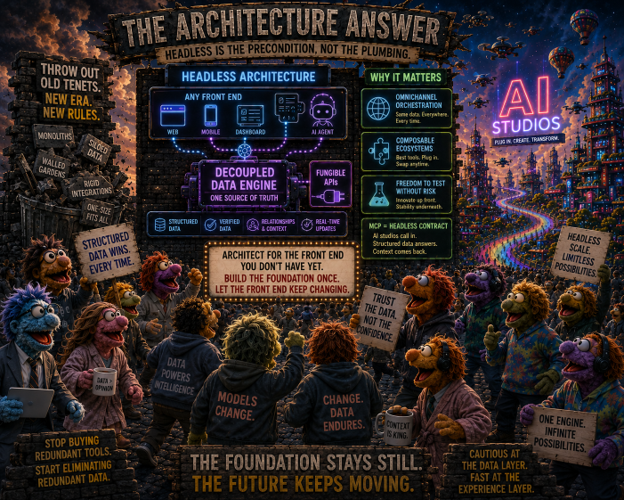
As stated, headless means separating the back-end data engine from every front-end touchpoint that uses it. Next comes "formulating solutions" — connecting front and back through fungible APIs instead of hard-wiring them together. In our AI equation, the data doesn't care where the request comes from: a website, a mobile app, a sales rep's dashboard, or now, an AI agent inside a studio. It just answers the call, correctly, every time, from the same source of truth. Context will still matter — more over time, not less.
That's not a nice-to-have. It's the precondition for the AI studio model to work at all:
- Omnichannel orchestration. When the data engine is decoupled from the interface, the same structured, verified information shows up identically whether a human requests it in a browser or an agent runs autonomously at 2am. One source of truth, infinite front doors.
- Composable, best-of-breed ecosystems. Headless kills the false choice between "build everything ourselves" and "buy one monolith that does everything poorly." You assemble exactly the components you need — best data layer, best studio, best vertical tool — and swap any one out without ripping up the foundation. This is the technical version of not scaling too quickly: you control where and how each piece plugs in.
- The freedom to test without breaking the core. New AI-native front ends — studios, agents, copilots — can be tried, broken, and replaced without ever touching the data infrastructure underneath. That's the difference between an experiment and a bet-the-company migration. Composable architecture lets an enterprise run both speeds at once: cautious at the data layer, fast at the experience layer.
Put plainly: MCP is a headless contract. It's the API that lets an AI studio call into a structured B2B entity graph and get relationships, attribution, and context back — instead of a pile of unstructured text it has to guess its way through. GraphIQ built the decoupled data engine on purpose, specifically so it could sit underneath whatever front end shows up next, studio or otherwise. Headless isn't the plumbing behind the AI studio story. It's why the AI studio story is possible at scale, not just in a demo.
What this means if you're building or buying right now
- Stop auditing your SaaS stack for redundant tools. Audit it for redundant data. Every point solution you bought was really buying its own copy of your business data, structured its own way. That's the actual bloat. Consolidating tools without consolidating and structuring the data underneath just moves the mess to a new interface.
- Ask any AI vendor the boring question before the exciting one. Not "what can your model do?" Ask: what is it running on, is that data structured, and can I verify it. If they can't answer cleanly, you're buying a confident guess wrapped in a nice UI.
- Architect for the front end you don't have yet. The studio you're using today won't be the one you're using in eighteen months. If your data layer is headless — decoupled, API-accessible, structured — the next studio just plugs in. If it's locked inside last year's platform, you'll have to migrate everything again. Build the foundation once. Let the front end keep changing underneath you.
Putting it all together
I have a framework from my days in social media: people buy a tool to build a process, and their culture has to adopt it. It's what made us successful selling social listening — you had to understand where their culture already was (how they did things), what process you'd actually fit into (crisis management, see the story at the beginning of blog 1), before you could be sure the tool delivered what they needed. Today, my argument is that all three of those pieces are being thrown into the air at once, and no one's catching them.
The tool is shifting from SaaS to a new AI-Studio-based model. Process is moving just as fast — away from one process everyone follows, toward individuals using studios to build their own custom workflows that answer their own questions in whatever way works for them. And the culture? The company is screwed, the same way it was in the social media days: it doesn't realize its own workers have already moved to a place where a magic interface efficiently tells them whatever they want to hear, without caring whether it's actually right or good.
Normally you can plant your feet on at least one of the three while the other two shift under you. Right now, none of them are holding still.
If that doesn't signal we're somewhere in the middle of a cataclysmic shift in how companies function, I don't know what would.
Remember: the model changes constantly. The studio changes constantly. The data layer — structured and decoupled — is the one thing that has to stay still.
FAQ
- Why isn't a better AI model enough to fix hallucination or bad decisions? Because AI = Models + Data. The model is the reasoning layer; the data is the knowledge layer. A better model running on unstructured or unverified data still produces confident, wrong answers — just faster. Hallucination rates drop 87% when models are grounded in structured data instead of unstructured sources (Atlan, 2026).
- What is "data blindness"? Running AI-powered workflows on unstructured, incomplete, or unverified data while trusting the output because the model presents it confidently. The output looks reliable. Whether the decision built on it is reliable depends entirely on the data underneath — which most teams never check.
- What is an "AI studio" in a B2B context? A workspace where a user thinks, builds, and acts using AI directly — as opposed to navigating between separate SaaS tools for each task. The studio becomes the interface; the value shifts to whatever structured data it's connected to.
- What does "headless" mean outside of e-commerce? Any architecture where the back-end data or logic engine is fully decoupled from the front-end experience, connected only through APIs. The front end (web, app, AI studio, agent) can change or multiply without the underlying data engine changing.
- How does MCP relate to headless architecture? MCP is effectively an API contract that lets an AI agent or studio call into a structured data source and get context back, the same way a headless CMS or commerce engine serves any front end that calls it. It's headless architecture applied to AI-native tools.