Why Smart Data Doesn’t Always Mean Trustworthy: Meet AI’s Confidence Gang
Part 2 of 3
Part 1 covered why the headless era is here and what it means to run on AI = Models + Data. This part is about the other half of that equation — why the models side alone can’t be trusted.
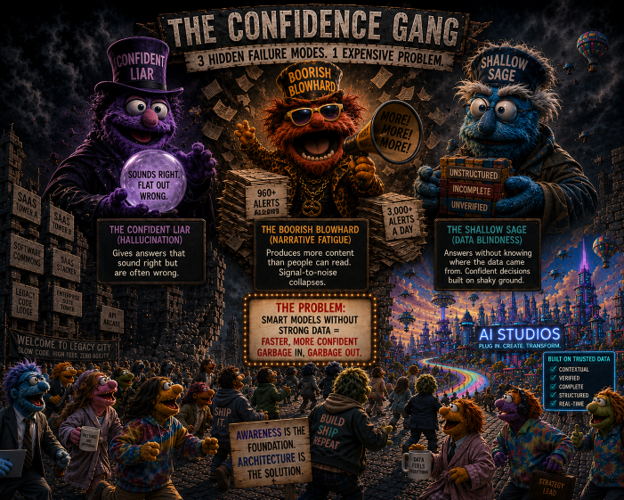
Picture this — you love sports and when you go to AI to help you remember the details about some fun fact about your favorite sports team, it literally spits back sports facts at you that even you know are….malarkey. You read them and the confidence with which it tells you a date, a score, trade details that never happened is astounding. It’s this moment I realized what a truly confident liar AI can be. It put my hackles up for all work I do in an AI studio, especially when I have no idea where it’s pulling the data from to answer.
That moment is not a glitch. It is the product.
Some of you might say the AI studio model is already amazing. I use ChatGPT, Claude, and Microsoft Copilot—already —and they do amazing things. But does it? On the surface, yes. The magic trick of answering your questions with data is impressive at face value. But the AI studio model has real issues affecting its effectiveness as a way to do business today, and until you recognize them, you can’t do anything about them. Awareness of the problem is the foundation for real change.
I’ve written about each of these on our blog because they’re not theoretical — they’re why “just plug in AI” keeps producing expensive disappointments. The three blockers of AI are the Confident Liar (hallucination), the Boorish Blowhard (narrative fatigue), and the Shallow Sage (data blindness). To frame just how much this matters: several outlets, including Forbes and AllAboutAI, have reported that AI hallucinations are estimated to have cost businesses $67.4 billion globally in 2024.
Let’s discuss AI’s often-ignored trio: the Confidence Gang.
The Confident Liar — What hallucination actually costs
The model gives an answer that sounds right, reads right, and is sometimes flatly wrong — with zero change in tone between the two. You trust a model with no data context behind it. You get confidence in an answer that turns out to be fiction.
What this looks like in practice:
That moment at the top of this post — the sports facts that never happened, delivered with complete certainty — is the Confident Liar in its most personal form. Now imagine that same confident wrong answer inside a sales motion. A market research report. A supplier decision. The tone doesn’t change. The certainty doesn’t waver. The answer is just wrong.
The Confident Liar can’t hide anymore — it’s been outed. Most people are hypnotized by the magic trick, though we’re slowly becoming Confidence Gang–aware. The other two, not so much.
The Boorish Blowhard — What narrative fatigue actually costs
The model doesn’t just answer, it performs — producing more polished output than any human can absorb. It produces more text than a person can use, faster than they can use it. Signal-to-noise collapses to zero, even when the content is correct.
What this looks like in practice:
The beauty of AI is how informally it allows you to chat with it to produce a common sense conversational and narrative answer to your question. But what happens when the head of sales calls a meeting and asks everyone to prepare for it. Then each person uses an AI studio to ask their question and each gets their own narrative answer neatly written in a formatted report. They all show up at the meeting. They have the answer to their assignment — oh by the way, it’s the same question for all. Who do you believe? How do you decide whose answer has the right data, the right output? Now imagine people running and sharing these narratives anywhere and everywhere. It won’t take long until no one reads anything and you are back to square one. Too much AI narrative becomes a process everyone tunes out and no one benefits from.
The math underneath the Boorish Blowhard is hiding in plain sight. We see him, but we haven’t felt the full weight of what he brings. Large enterprise teams already receive 960+ alerts a day; organizations over 20,000 employees hit 3,000+ — and only 30% of it is actionable (Parse Labs, State of Revenue Intelligence 2026). Building a beautiful AI process without discipline, process, or scale doesn’t shrink the Boorish Blowhard’s impact. It force-multiplies it.
The Shallow Sage — what data blindness actually costs
Running AI workflows on unstructured, incomplete, or unverified data — and trusting the output because it’s delivered with confidence. Believing the model can answer without knowing where the underlying data actually came from. Fast, confident decisions built on a foundation nobody checked.
What this looks like in practice:
A market development team uses their AI studio to find and learn everything they can about the competitive landscape. The system only uses the web to shallowly pull a bunch of high level facts from scattered sources across the web. You have no context where it came from, no idea how they are interconnected and most importantly no attribution. Only a contextual knowledge graph can create meaningful facts that are interconnected to give you answers you can trust and not puddle level facts sprewed at you in a narrative with utter confidence that can be blatantly false.
Hallucination rates drop 87% when a model is grounded in well-structured data instead of unstructured sources (Atlan, 2026). Same model. Different foundation. Different outcome. That’s the whole argument in one data point — AI = Models + Data, and almost everyone is still obsessing over the wrong half of the equation.
So the studio model doesn’t fail because the idea is wrong. It fails the same way every SaaS tool before it failed, when nobody thought about the plumbing: plug real intelligence into a data layer with no structure, and you get a faster, more confident version of garbage in, garbage out.
Which is why the conversation has to go architectural.
FAQ
- What is AI’s “Confidence Gang”? A shorthand for three AI failure modes that all share one trait — unwarranted confidence: the Confident Liar (hallucination), the Boorish Blowhard (narrative fatigue), and the Shallow Sage (data blindness). Each looks like fluency. None of them is accuracy.
- How much do AI hallucinations cost businesses? Outlets including Forbes and AllAboutAI have reported AI hallucinations cost businesses an estimated $67.4 billion globally in 2024.
- What is narrative fatigue in AI? It's what happens when a model produces more polished output than anyone can read or use. Large enterprise teams already receive 960+ alerts a day, and orgs over 20,000 employees hit 3,000+ — with only 30% of it actionable (Parse Labs, State of Revenue Intelligence 2026).
- What is data blindness in a GTM context? Running AI-powered workflows on unstructured, incomplete, or unverified business data, and trusting the output because the model presents it with confidence — even though nobody checked the foundation underneath.
- Does structured data actually reduce hallucination? Yes — hallucination rates drop 87% when a model is grounded in well-structured data instead of unstructured sources (Atlan, 2026). The model doesn’t get smarter; the data layer improves.