Claudeflation: Why Your 2027 AI Budget Is Already Wrong
Token prices are subsidized today. Once AI labs answer to public shareholders, that math changes. Here's how RevOps leaders can plan CY2027 budgets for it.
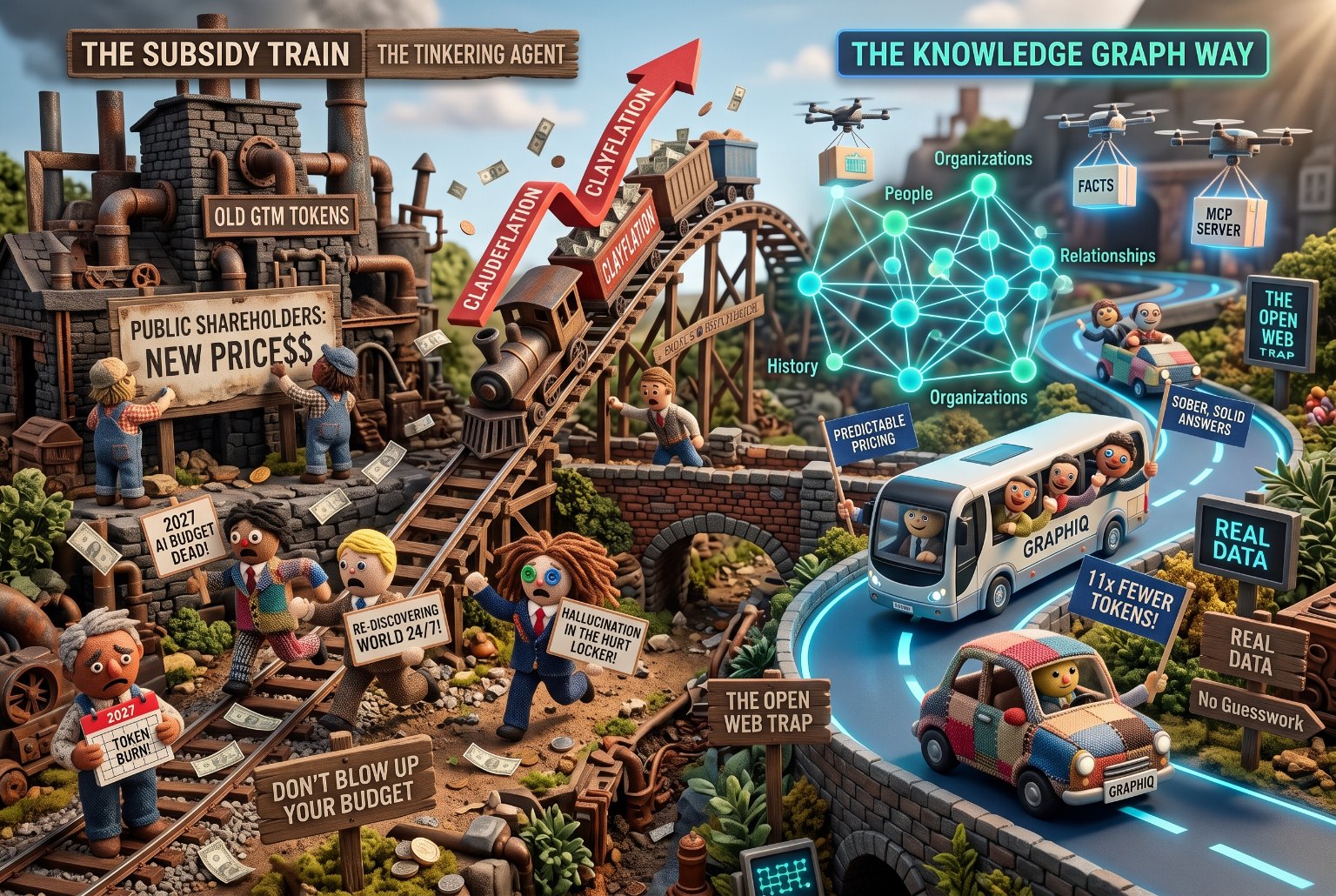
Budgeting season is bearing down upon us, and CY2027 planning is already stressing out every RevOps leader I know. Few are looking forward to submitting that budget request to their CFO. Fewer still are thinking about the fact that token prices are about to climb. The train is coming. Sh*t is about to get real. Claudeflation is about to put RevOps leaders across the world into the 2027 vintage hurt locker.
What is Claudeflation?
Claudeflation is the rise in AI token costs I expect as frontier model providers shift from growth pricing to profit pricing. Its cousin, Clayflation, is what happens when tools built on those models (like Clay) pass the higher cost through to you.
The subsidy is ending: why AI token prices will go up
Because the subsidy ends when the shareholders show up. On June 1, 2026, Anthropic confidentially filed a draft S-1 with the SEC, days after a Series H that valued it at $965 billion. OpenAI is reportedly preparing its own filing. Timing depends on market conditions, but the direction is clear.
As of now, our frontier labs are still burning investor cash to subsidize your runaway token use, keep the fierce market share fight going at full bore, and keep your token bill manageable while you build more and more critical business processes on top of them. Once they answer to public markets, today's math is no longer mathin'. Margins matter. Earnings per share matter. My bet: prices go up. They have to.
We've seen this movie before. Lyft went public in March 2019 and killed what I called "The Millennial Subsidy." Two months later, Uber followed suit. For years, with gobs of VC money, the pink and black rideshare twins kept prices artificially low in a battle for market share. Once they had to answer to public shareholders, that subsidy vanished. If you'd gotten used to a ride home for less than the price of a ham sandwich, it sucked. My buzzed ride home from Rickhouse to my place on Valencia Street went from $5 to $27. Overnight.
Same movie, new cast. This time it's Anthropic vs. OpenAI. Claude is about to become a very expensive friend to hang out with. Let me introduce you to a new friend who cuts the tokens you spend with him by 11x, won't bullshit you, and won't leave you holding the bag.
Clay is on the same ride: what is Clayflation?
Clayflation is Claudeflation passed through a middleman. On September 9, 2026, Clay raised $115 million at a $7.1 billion valuation, up from $5 billion in a January employee tender. That's a lot of capital chasing an agentic workflow tool that burns credits on every task.
Most users don't think about what powers Claygent: third-party frontier models. When those tokens cost more, Clay's costs go up. Somebody pays that bill, and it won't be Clay. Clay is not immune to Claudeflation any more than you are. It will just pass the additional cost through. To you.
The brutal "Rediscovery Math": why AI agents burn so many tokens
Because they rediscover the world from scratch every time. As Tony Seale puts it, agents spend tokens working out what things mean, finding the right information, and reasoning with each other. Every search starts that process over.
Don't take my word for it. Ask Claude in research mode how many subsidiaries Disney has and watch what happens. It spins up agents to scour the web. They huddle up and share their answers. Another agent QAs the result. Yet another organizes it all and hands it to you. You don't see the token bill until the work is done.
Now multiply that one prompt by every rep, every account, every week of 2027. Try forecasting that line item. Your CFO will know you're lowballing before you walk in, and you'll both know you'll be back, hat in hand, by the end of Q2. Not a good look.
Hallucinations are for the weekend
Ask an LLM to map parent and child companies, find lookalike accounts, or surface decision-makers in your ICP, and it will often answer with total confidence, sources or not.
We've all fallen for it, present company included. Claude doesn't just sound right, his answers are often pitch-perfect. Confident. Sharp as a tack. Heck, he probably even subtly compliments you in the process. But that velvety voice can mask a sharp set of teeth. They'll bite you when you realize, too late, that your boy Claude has confidently hallucinated his whispered answer into your ear and left you holding the bag. Because instead of checking his work, you pushed the "I believe" button and went on about your day. As Homer Simpson would say, "D'Oh!"
A hallucinated subsidiary list doesn't just cost tokens. It costs you a bad territory plan, a wasted SDR week, and a blown pitch to your CRO. Business-critical data is not something a model should guess about. Could easily cost you your whole weekend, too. Do you really want to spend it auditing your business-critical FY27 planning docs for accuracy? Or would you rather go see My Chemical Romance with your bestie?
One call: how to cut token costs without giving up AI
Keep the model. Stop making it rediscover the world. Point it at data that's already structured, resolved, and cited.
When we built GraphIQ, we had no idea Claudeflation was coming. We just wanted a useful identity graph that tells you everything about every company you care about. Now, on the eve of what I expect will be an eye-watering price hike for critical business data, we're proud to offer relief. Because we already did the messy work of building the ontologies (read: relationships): resolving and connecting 287 million organizations, 393 million people, and more than 2 billion news articles.
So instead of an agent burning tokens to build your list, you connect Claude (or any MCP-compatible agent) to the GraphIQ MCP server and ask the graph:
- Parent, subsidiary, supplier, and customer relationships
- Lookalike companies
- Technographics and locations
- People, new hires, and likely buyers
- Funding events and news
All of it already mapped, resolved, and connected. When you need a correct answer, you make one call to GraphIQ and skip the expensive, repeat trip your agent would otherwise take to rediscover the world from scratch. You get a fully attributed, sober, solid answer you can defend to your CFO. At a predictable price.
Don't blow up your budget: how much can a knowledge graph save on tokens?
In our early benchmark, about 11x. We asked frontier models almost a hundred real customer common GTM questions in the last month - asking it to come back to us two ways: web search alone, and web search plus GraphIQ. Then we compared tokens used and answer quality.
Full disclosure: some questions showed no token savings. Even then, the answer was better when the model could reach the graph, because it came back structured and sourced.
11x is not a rounding error. That's real budget you get to keep. Your CFO will thank you.
What are you waiting for? How RevOps should budget for tokens in 2027
Assume Claudeflation is real and Clayflation follows right behind it. You could sandbag the hell out of your budget request and hope for the best. Or you could skip the guesswork and shrink the exposure:
- Inventory your token-heavy workflows. List every agent, enrichment, and research flow that calls an LLM to look up company or contact facts.
- Split lookup from reasoning. Facts that don't change per prompt (hierarchies, firmographics, contacts) should come from structured data. Save frontier tokens for judgment, writing, and analysis.
- Price a stress case. Model your 2027 token line at today's rates and at a meaningfully higher rate. Show your CFO both.
- Move lookups to a fixed-price source. Route them to a graph or API with predictable pricing, and cite where every answer came from.
- Re-measure quarterly. Track tokens per workflow so a price change shows up as a number, not a surprise.
FAQ
Will AI token prices go up in 2027?
Nobody outside the labs knows for sure. Anthropic has filed confidentially for an IPO, and OpenAI is reportedly preparing to. Public companies face margin pressure, which makes today's subsidized pricing hard to sustain. Budget for that risk.
What is Clayflation?
Clayflation is the pass-through of rising model costs by tools built on frontier models, such as Clay's AI agent, Claygent. When the underlying tokens cost more, credit prices tend to follow.
Why do LLMs hallucinate company data?
LLMs predict plausible answers. For facts like subsidiaries, org charts, and contacts, a plausible answer and a correct one can differ, and the model sounds equally confident either way.
How does an MCP server reduce token usage?
An MCP server lets an AI agent call a structured data source directly. The agent gets a resolved, cited answer in one call instead of searching, reading, and reconciling many web pages.
What is GraphIQ?
GraphIQ is an AI-native B2B identity graph covering 287 million organizations, 393 million people, and more than 2 billion news articles. It's available through a web app, REST API, and MCP server.
Save your tokens
Admit it: like everyone else, you've built business processes that consume tokens the way your kids consume sugar on their morning cereal. Tokenmaxxing had its day in the sun, but those days are long over. Save your tokens for the work only a frontier model can actually do. Skip the permanent surge pricing and call the graph instead.
So here's my question: if your token costs doubled tomorrow, which of your GTM workflows would you shut off first?
Sam Featherstone is VP of GTM at GraphIQ.ai. Try the GraphIQ MCP server.