If AI Only Had a Brain
The math the business world is missing
The AI business landscape could kindly be called the “wild west.” We’re all trying to figure out what it does to our jobs, how it drives ROI, and how to harness the power everyone keeps promising. Leaders are pouring millions into AI initiatives, staring at dashboards, waiting for the magic.
But the story keeps falling flat. And frankly, I think we’re fighting that fight with half the picture.
One equation explains the whole thing:
AI = Models + Data
AI is only complete when the models powering it are fed the data they need to produce answers worth acting on. And if that’s true, then the entire market has been trying to model its way out of a data problem.
Gartner put a number on it. Across 1,203 data management leaders,
of organizations either didn’t have — or weren’t sure they had — the right data management practices for AI.
Their prediction: through 2026, organizations will abandon 60% of AI projects unsupported by AI-ready data.
Not abandoned because the models weren’t good enough. Abandoned because the data wasn’t ready.
And notice the words Gartner used. Not more data. AI-ready data. Those are two very different things — and the difference is the rest of this post.
The Scarecrow problem
Think of the Scarecrow from The Wizard of Oz, out in the cornfield, singing to himself. If I only had a brain.
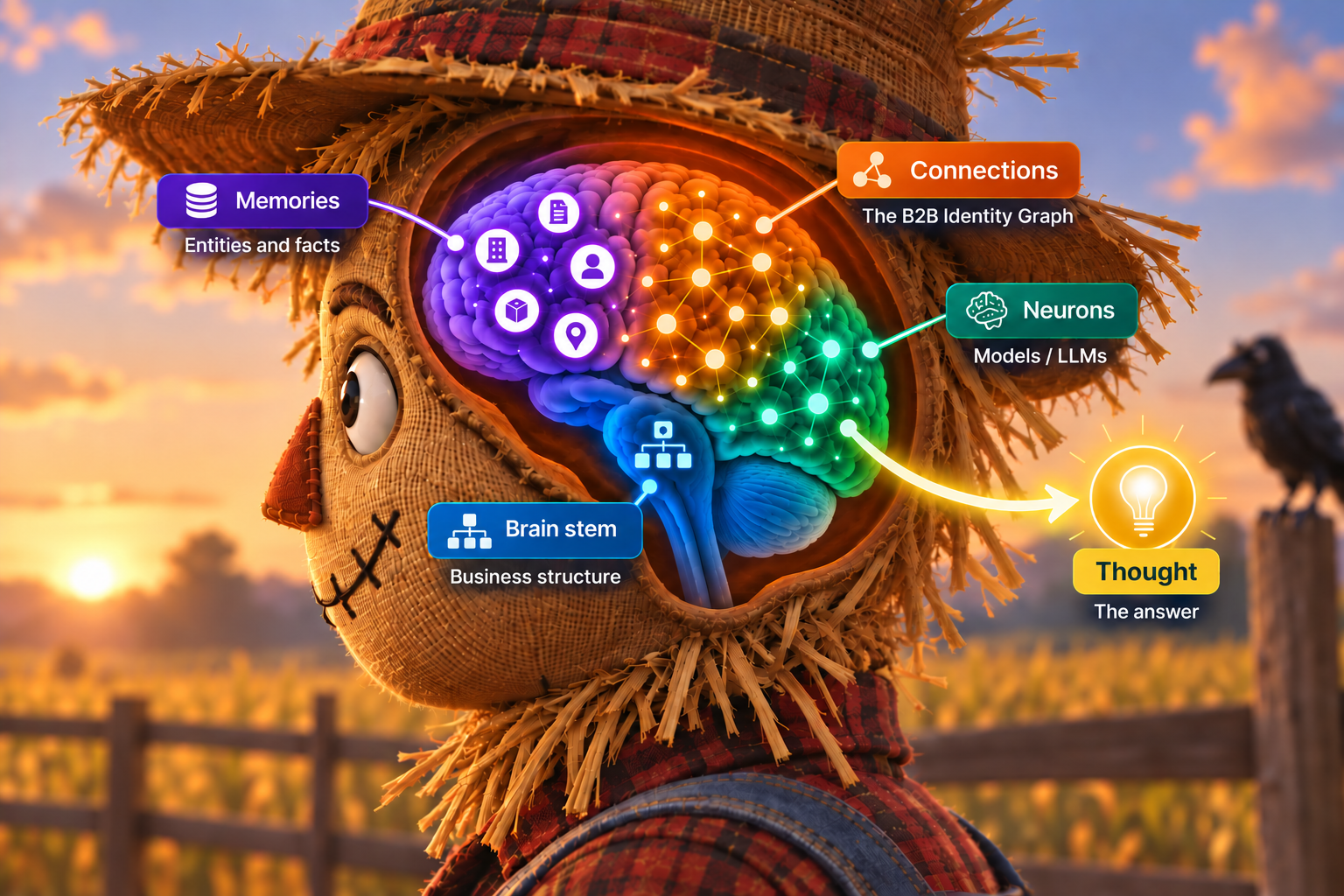
Today’s AI is a very sophisticated Scarecrow. The models we’re all in love with are his neurons, and they’re extraordinary at firing, connecting and reasoning. So the industry keeps stuffing his head with more of them. Bigger models. Faster models. Longer context windows.
But a neuron doesn’t store anything. It holds the strength of a connection — a probability of firing. That is exactly what a model parameter is. An LLM’s weights are synaptic strengths. Nothing more.
Here’s the part that should stop you. The human brain runs roughly 86 billion neurons against 100 to 500 trillion synapses. The connections outnumber the neurons by more than a thousand to one. The neurons are the hardware. The connections are the knowledge.
And a neuron fires all-or-nothing. It doesn’t hedge. It crosses the threshold or it doesn’t — which is precisely why AI will look you in the eye and confidently tell you something it invented. The Scarecrow’s neurons fire whether the knowledge is there or not.
The model isn’t failing or even flawed. That’s simply what a neuron does.
Spreadsheets are not a brain
I worked at Clorox for 10 years. And when I told people that, they’d say, “Oh, so you work at a bleach company.” I would try not to get offended.
So I’d ask them if they liked Hidden Valley Ranch. They’d say yes. Clorox makes that. Did they like BBQing? Kingsford Charcoal — also Clorox. Then I’d keep going. 409. Tilex. Fresh Step. Brita. And they’d be shocked every time.
Here’s what I didn’t realize I was doing. I was walking a B2B entity graph out loud. I knew the entities, the connections and the facts. They were AI with bad data.
Now put your AI in their chair — making that same wrong assumption over and over, force multiplying the error at every hop.
Take just one of those brands. Search a resolved entity graph for “Brita” and fifteen separate organizations come back. Which one matters?
- The Clorox subsidiary in Oakland?
- One of the three Brita entities incorporated in Delaware?
- Or BRITA SE — the German family company, founded in 1966 and named after the founder’s daughter, that licensed the brand to Clorox for the Americas in 1988 and still owns it everywhere else in the world?
A spreadsheet can’t tell you. A CRM doesn’t even try — it can’t resolve entities, and it can’t follow them across long strings of fact. Strings of things. So it creates duplicates instead, which is why two reps call the same account on the same day. It’s why dashboards really stink.
A B2B entity graph resolves them. It knows which of those Britas are Clorox, and which one is a company that only looks like it.
The anatomy of AI-ready data
So let’s map the math onto an anatomy every one of us already carries around.
Brain stem
The foundational map of the business world. Take Boeing. Map it as one entity in Virginia and AI thinks it makes airplanes. Map the hierarchy properly and you get 182,000 employees across 677 locations and more than a hundred subsidiary entities spanning defense, space, software, training and parts distribution.
Memories
Entity resolution. Taking facts loose in the world and attaching them to exactly the right company, person or place on that structure.
Connections
A company owns a subsidiary. A person works there. A customer buys the product and puts it into their own supply chain. The relationship is the verb that sews two entities together — and it’s the context models are missing.
Neurons
Wire them into everything above and they finally have something worth firing about.
Thought
AI stops generating plausible language and starts assembling an answer grounded in fact.
That’s what AI-ready data actually means.
so the model knows what it’s looking at.
so it knows two records are the same company.
so it knows how that company relates to everything else.
so it knows which of those relationships matter to the question you just asked.
Four words. That’s the brain.
Meaning over math
The market keeps believing that if it just builds a bigger, better neuron factory, it will solve every business problem in the world. But more neurons doesn’t mean better connections.
Models give AI the ability to think.
Data gives it something worth thinking about.
Relationships give that data meaning.
AI = Models + Data
Maybe AI didn’t need another model. Maybe it just needed a brain.
Because without one, the Scarecrow can still talk to you. But what he tells you may be nothing more than a pointless conversation dressed up in eloquent dialogue, leading you right off the yellow brick road.