The AI Studio Era: The Headless Horseman Is the Villain You Don’t Have to Fear Anymore
Part 1 of 3
Fifteen years ago, social media flipped the script on who controls a brand. A shift of the same size is happening to the software stack right now — and it is moving a lot faster.
Fifteen years ago, I had the privilege of living through the last major tech revolution — the social listening era (and some regret, watching what it’s done to all of us since). I thought things were moving fast then. One of the “I was in the room” moments of my career happened on a trip to New York, sitting in a meeting with one of the largest CPG companies in the world. They were there to figure out what to do about social media. I was the one startup guy in a room of fifty-plus consultants, executives, and PR people. I had no idea why I’d been invited. I’ve never forgotten that room.
No one in that era ever priced out what a social PR crisis actually cost. Back-of-envelope: get ten executives in a room for two hours at $1,000 an hour each, just to start discussing the crisis — that’s a $20,000 meeting. And that’s before anyone beneath them spends the next week studying and answering for it. Each blowup could run six figures, easily.
What I watched from the corner of that room was something I’d felt building for three years as a Chief Evangelist. The CEO kept swinging the company back and forth at the whim of a single tweet. It’s a familiar movie beat — a room full of noise, everyone talking over everyone else, and then one voice cuts through just loud enough that everything stops and every head turns to find out who spoke and why. That’s what happened next: I said, “Hey everyone, you need to face it: you don’t control your brand anymore… anymore… anymore.” The room went silent. I felt the heat of the spotlight, and I explained: social had flipped the script. You used to own the message. It doesn’t work that way anymore, and it’s not going back. One of the most senior people in the room nodded, absorbed it, and the whole room changed direction with him.
That shift took years to fully manifest. This one won’t wait that long. What’s coming is at least as large a cultural shift, and the market isn’t ready for it.
Just to drive the point home, Gartner projects that by 2028, 90% of B2B buying will be AI agent intermediated — over $15 trillion in B2B spend flowing through AI agent exchanges. Fact: the SaaS category isn’t shrinking a little at a time — it’s about to melt like a block of ice thrown into a furnace. The consumer is always the boss, even in B2B — and consumer adoption of AI has already set the expectation: ask a question in a chat interface, get an answer like magic. The business market has been slow to catch up to what its own buyers already expect at home. If your product only exists as another login in someone’s browser tab, you’re building for a world that’s already ending.
I’ve been saying AI = Models + Data for over eighteen months. Most people still treat the model as the whole equation. It isn’t, and it never was. But that’s only half of what’s changing. We’re in a two-step shift: data is the first half. The second is the modality — the interface you actually use to get your answers — and it’s about to upend how all of us make sense of anything. The headless era is here. You’d better be ready.
So what is the headless era?
Simply put, SaaS was revolutionary — you could buy a specific interface to solve a specific problem in your company’s process, a function’s need, or a person’s way of communicating with the business. It was beautiful. No more eighteen-month rebuild cycles — you got a seamless solution that improved automatically, just by buying in. Processes got faster. Systems started talking to each other. The world was wonderful.
But that world created other major issues. While everyone solved their own pain point with SaaS, they were quietly building a Frankenstein of a process. Each function built its own process, run by its favorite solution. Sometimes different parts of the same function, in different divisions, bought different solutions for the same job. And so on. During the SaaS era, people thought they were architecting a solution stack. The truth is they were accumulating one — a Jenga stack, one block away from falling apart.
Enter the headless era. And it isn’t happening because SaaS got worse.
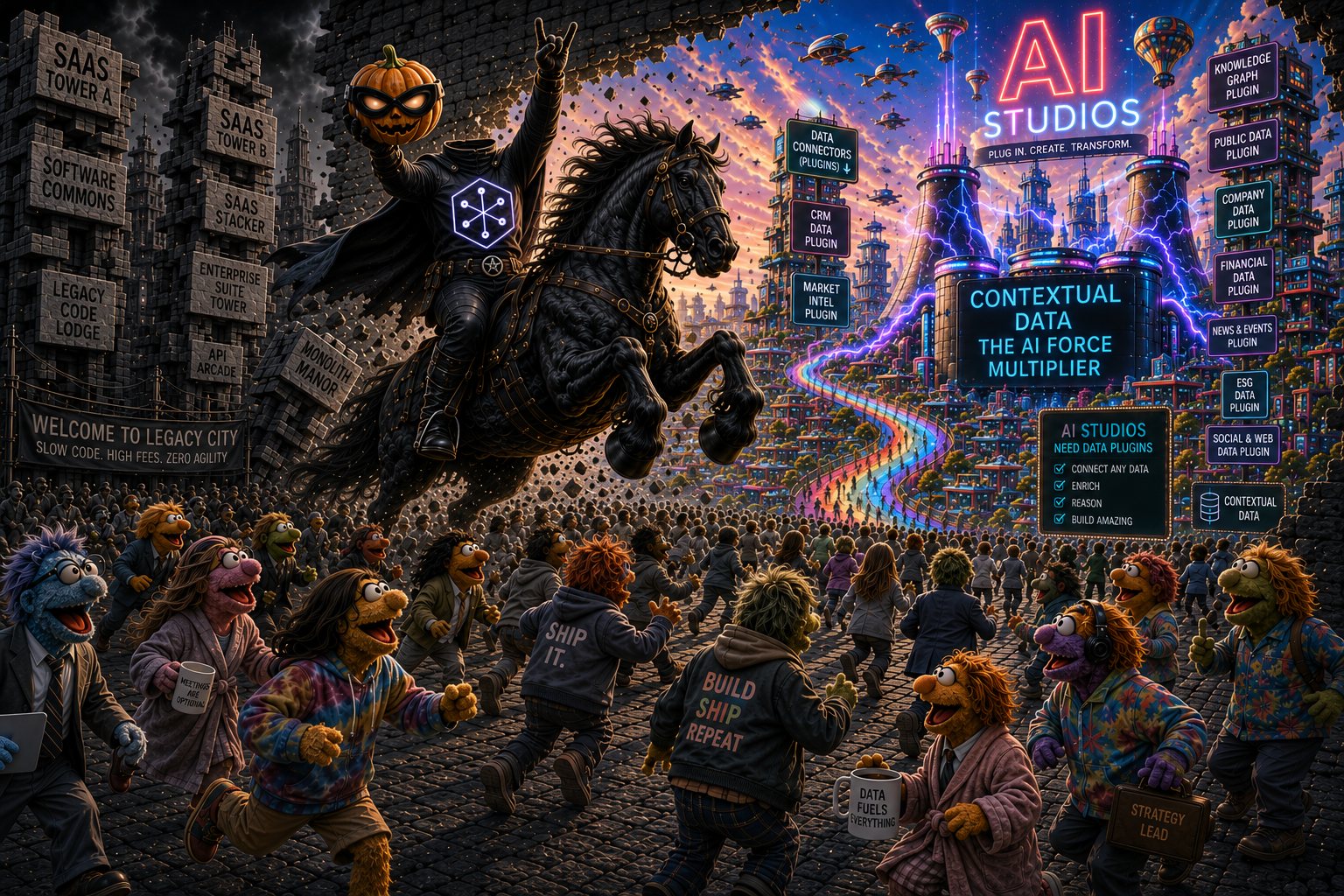
First, let’s define what the headless era actually means — because, like all good change, coalescing around a definition is what makes it real. The headless era means the way we work changes. Instead of a million point solutions, picture AI = Models + Data moving from a math equation into your everyday work. It’s about translating that equation into the actual product you use to do your job. You’re already doing it. Concretely: it’s decoupling the front end from the back end. The front end becomes an interface built on models. The back end becomes a set of data connectors feeding the right data into that same equation. That’s the whole idea. The headless era is about picking your favorite front end and configuring the back end with whatever data you choose — so you get the shortest, most accurate answer to whatever you need.
It’s evolving at light speed because the SaaS era was like buying a new filing cabinet for every document you own — each one neatly organized, and you never actually know what’s in any of them. Today’s headless era is being driven by the AI Studio — a place where you can wax poetic, think, create, build, and act, plugged directly into the data layer you need to answer any question about your business. As a founder, I’m doing it every day now. I’m plugging an AI studio into GraphIQ’s own MCP server to create a kaleidoscope of answers for any customer who asks. Ask any question, and the studio reaches into structured, contextually connected external business data to build an answer — quickly, efficiently, and connected to reality. You get a real answer instead of a dashboard you have to interpret. No twelve-tab context switch. No exporting from Tool A to import into Tool B so Tool C can make sense of it. Just a headless world, powered by models that need data.
But I’d argue smart data, not just data.