The AI Proletariat Are Gathering Their Forces
Companies think they control their AI strategy. They don’t. From the ashes of rigid SaaS workflows, an “AI Proletariat” is rising—workers empowering themselves with $20 subscriptions to build better, faster processes. Read how this fundamental shift in venue, mode, and means is democratizing power and threatening the very foundations of corporate control.
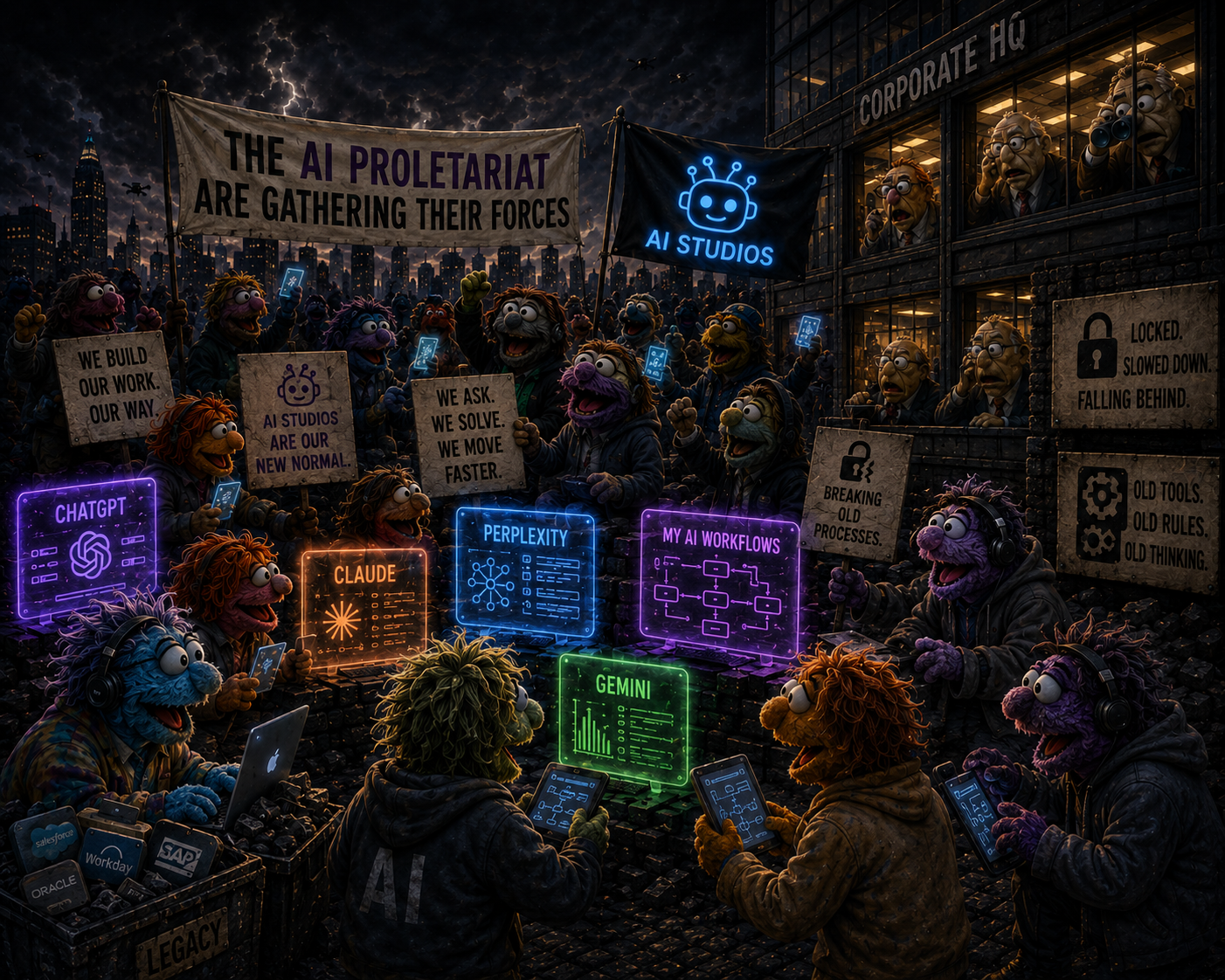
Let me tell you about Tom.
Tom is a local salesman at an industrial company. Like most companies in his industry, they are a bit behind in what most tech people see as obvious. His company decided its toe-in-the-water AI strategy is to do the safe thing and buy Microsoft Copilot - an AI extension of their software suite that is safe, known, and an acceptable level of risk for the organization. Call it a way to be AI forward with the usual dose of corporate control.
Tom’s job is to sell. He has a small territory. Finding new opportunities is hard in such a limited geography. In a recent catch-up, he asked me a very interesting question. He loves what GraphIQ.ai brings him and swears by our interface for the magic it provides. As we talked, he asked, “Hey, I love what you have built, but honestly, do you guys work with Claude?” He told me he doesn’t like what he has at his disposal and is building amazing processes on his own.
My jaw dropped when all the pieces clicked right into place: companies have lost control of how they operate, and they don’t know it.
Tom is not an anomaly. He is the revolution. There is an AI revolution happening in the bowels of your company right now, and it is not being televised.
Most of us are fixated on how AI will boost productivity - or how it’ll be misused. Both are real. Neither is the story you’re missing.
For twenty years, companies built real discipline around SaaS: a repeatable, controllable process for how software enters the business. That discipline is breaking, faster than most leadership teams can track. I’ve seen this movie before - fifteen years ago, I watched marketing completely lose control of its brand message when social media went mainstream. Panic filled the air as companies made the same unforced errors over and over, because they were used to controlling the message and they suddenly couldn’t.
An equally terrifying loss of control is about to hit corporations - except this time, your own workers, the proletariat of your organization, are revolting.
The Consumer-Behavior Revolution
This change is not the “all of a sudden” you think it is; this revolution has been subtly brewing over time. A cultural undertone is emerging that companies are missing. The reality is the worker, the user, and the consumer will lead this change - not the market. Why? Because of the ever-elusive thing product people often miss when designing products: the moment when the unarticulated need meets the consumer-perceivable benefit. What makes this revolution magical is how corporations have taught consumers to expect better.
It started on a phone, indirectly, when Siri in 2011 taught a generation that you could just ask and get an answer. Over time, Grammarly taught them that something as annoying as grammar could be improved with help. Years before ChatGPT blew up in 2023, Google had already started suggesting what the next thing you wanted to type would be. Consumers learned there was a better process for creating, doing their work, and getting support for their ideas. We have been part of a consumer-behavior revolution unfolding in the back of our minds for the past decade. Workers aren’t waking up to discover AI - they now expect work tools that match the expectation slowly set for them by the indirect AI innovation foisted on them without them realizing it.
The Power Shift
This isn’t the first time this type of revolution has caught people off guard. I have been watching this predictive mechanic play out for years, and I call it the Power Shift. Simply put, as technology evolves, it hands the individual a gift once controlled only by lumbering institutions: access to power through more accessible, cheaper, amazing technology.
Today, it will be even more disruptive than social media because it’s amplifying a worker’s skills and knowledge. The Power Shift is a much larger story than this current AI revolution - it’s about how every technology era has further democratized who owns the market.
There are three key elements to the Power Shift:
- Venue: The concrete delivery system - where the work actually enters.
- Modes: The manner of productivity delivery - how you actually work within it.
- Means: The money - the economics of getting the work done.
What is the shift in Venue? SaaS is now an old venue. A company’s adoption of SaaS tools created strong cultural guardrails around the scalable process needed to drive repeatable corporate predictability, creating a natural defense against innovation. AI, however, literally ignored the front door and is entering through the basement. Your workers have empowered themselves with a $20 subscription to the AI studio product they prefer. The venue moved from inside your company’s control to outside the building, which you still mistakenly believe you control.
What is the shift in Mode? Sure, the actual modes are still a computer and a phone, but we now have a generation trained to chat their inputs to get the exact output they want, quickly and efficiently. If you don’t think they might rebel against your expected, overengineered, mandated workflow, then you are delusional. The mode shifts from clunky, cumbersome software you have to follow, to a free-form mode of limitless creation, context, and understanding.
What is the shift in Means? If something so magical can be purchased on its own, and you are scaring them about how AI will replace them… aren’t you just encouraging them to rebel and show how much better they are at what they do? AI Studios have literally just blown the top off all your millions of dollars of investment in every SaaS product you have. In a studio, when you simply plug in the right data, it can do just about everything your clunky, disconnected SaaS world can do - in a single place, with about 100x less miserable frustration.
If I am honest, I am eating my own dog food here as well. AI is my own personal unlock. Being able to simply bring my biggest ideas out of my head, in whatever form I need assistance processing them, is a force multiplier of my own ideas. I didn’t write this piece alone, either. I built it in an AI studio, back and forth, sentence by sentence, until the shape I could already see finally matched words someone else could read. That’s not a caveat. That’s the proof.
Welcome to the AI Power Shift That’s Going to Disrupt Your Whole Company
Go back to Tom. Here is a guy in an industry that doesn’t adopt technology quickly, using his own personal AI studio because what he was given didn’t do the job. He wanted to merge the power of our Identity Graph with his preferred modality of work. This man is a revolutionary. He is finding any way he can do his work in an AI world, to ensure he hits his metrics - sanctioned technology be damned. He empowered himself by taking what AI has been teaching him over time and turning it into a successful process of his own.
Now imagine there are 100 more of him lurking in your company, doing their job the way they see fit, not the way you see fit. If you don’t think that thousands of your workers moving in multiple directions throughout your organization is going to disrupt that wonderful cultural predictability every large company craves, then you should quit - or better yet, be fired.
Now imagine this power in the hands of AI-native companies that understand the scale it brings to their work. To put it mildly, each Power Shift leads to cheaper, more efficient means for companies to do work. With an AI studio plugged into the right data, a company of 10 will be like a company of 100. Able to grow and scale before you even notice it’s happening. Right now, the revolution in your walls is disrupting your normal order of business, undermining predictability and leaving you vulnerable to destruction by those who build their foundation on these new bricks.
Advice to Ensure You Aren’t a Casualty
- Recognize and trust your revolutionaries: You must find and reward them. They are actually doing you a favor by forcing the culture shift of how people work in a consumer-driven manner. Don’t resist; ask them to demonstrate.
- Sprint toward processes that drive customized scale: Customized scale is what AI studios are offering you - a way to let your workers use a standardized tool with trusted datasets that allow them to decide how they want to build solutions. You know and trust the results because the models are extracting answers based on information you trust.
- Recognize the Power Shift: This isn’t just about the revolution; it’s about the danger living around you outside your organization. Companies that understand this revolution are plotting your destruction. Slapping AI on a SaaS product is like putting lipstick on a pig. AI = Models + Data, and if you are just using models in a SaaS environment, you aren’t really understanding Tom. He is doing something else entirely.