Blog
Insights
The Salesman’s Conundrum
Discover why finding the right company is the biggest hidden hurdle in B2B sales. Learn why standard Generative AI prompts fail at building reliable prospect lists and how using Knowledge Graphs to create "Capability Fingerprints" transforms your Total Addressable Market from a guess into a science.

Malcolm De Leo
CBO

Salespeople live for the signal. It is that subtle moment when a buyer shows interest. It is the spark that sets off the chase. Ask any top performing rep what keeps them up at night, and they will tell you the same thing. If I can just find the person who wants to buy, I am golden.
They are not wrong. Finding people who are ready to buy is in many ways the holy grail of sales. But here is the kicker. Before you can find that person, you need to find the right company. Trust me when I say that is often the much harder problem.
The Harder Part of the Hunt
Two years ago, I spent two months interviewing over 40 executives across different industries. I was looking for shared market pain. I wanted to find the kind of ache so real and persistent that it is practically begging to be solved.
I did not have to dig too deep.
Every single leader I spoke with said the same thing. From supply chain chiefs to sales leaders and general managers, the message was identical. They told me there is no easy way to find the right companies to do business with.
Let that sink in.
They were not saying it is hard to pitch or hard to close. They were saying it is hard to even start. It is hard to find suppliers. It is hard to source partners. It is hard to locate customers. It is even harder to find the experts who could help them move the needle.
So how were they solving this?
Honestly, they were not. Most just leaned on Google, hired expensive consultants, or called up people in their network. It is a patchwork approach built on gut instinct and proximity rather than scalable insight.
But Wait, Isn’t That What AI Is For?
This is usually the moment someone asks why we cannot just use ChatGPT.
It is a fair question. On the surface, it sounds like the right play. Ask a large language model to identify companies that buy widgets or sell them, and you will get an answer.
But here is the problem. It is not repeatable. It is not verifiable. And it is definitely not precise.
Generative AI is not yet built to map business ecosystems. What you get back is a story or a narrative. That narrative changes every time you ask. That might be fine for brainstorming or exploring concepts. However, if you are trying to build a high confidence sales target list, it is more like rolling dice and hoping for a miracle.
The Answer Isn’t in Prompts. It’s in Structure.
What we need isn’t another clever prompt. What we need is a better foundation. We need a knowledge graph.
A knowledge graph is about facts. It is about linking real, verifiable data points together in a way that makes the messy and complex business world more searchable, navigable, and actionable.
When you build that graph around companies instead of just keywords, you unlock something powerful.
You begin to create what I call capability fingerprints.
What’s a Capability Fingerprint?
Think of it this way. What if you could take everything a company does and translate it into plain and searchable language? That includes its products, services, technology stack, certifications, and target markets.
That is a capability fingerprint. You can see what it looks like below.
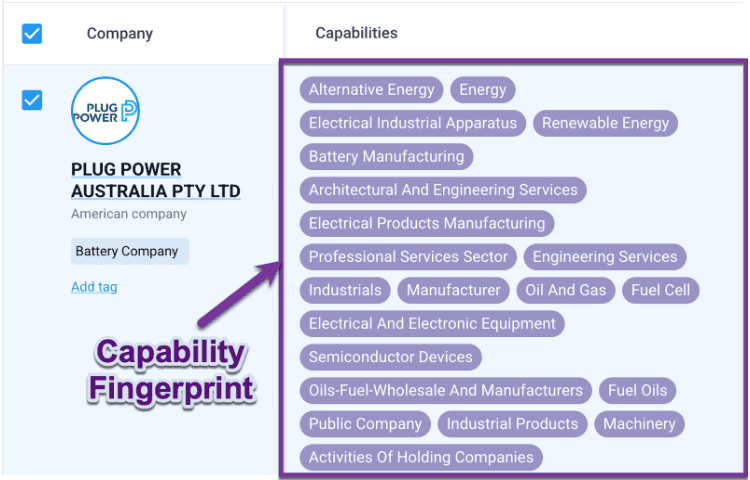
It is like giving every company its own DNA sequence that is tied to how it operates in the world. Now imagine being able to compare those fingerprints across thousands of companies. You can filter by function, industry, capabilities, or markets served.
Suddenly, your Total Addressable Market is not just a back of the napkin estimate. It is a living and breathing universe of real targets built on verifiable traits instead of vague firmographics.
From Spray and Pray to Search and Match
With a capability first view of the market, business development transforms. Supplier discovery becomes smarter. Sales targeting becomes faster. Partnerships become easier to map.
That is the real promise of knowledge graphs. They do not just organize information. They give you control.
Instead of relying on black box narratives from an LLM, you are searching across interconnected facts. These are facts tied to real companies with real needs.
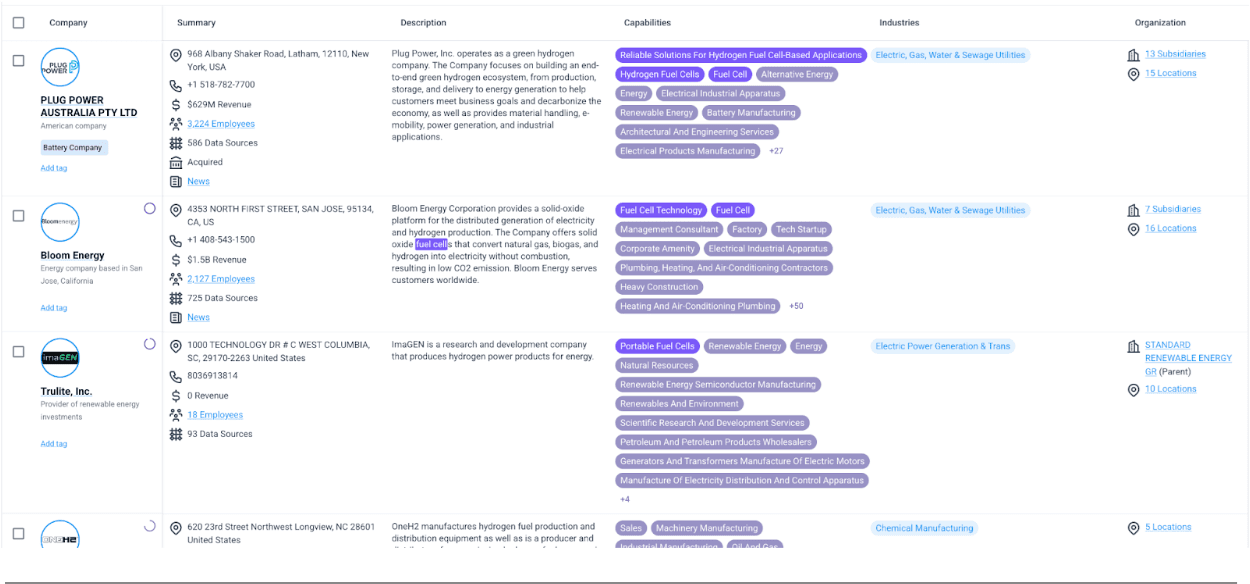
Once you see this shift, it is hard to unsee it. You stop rolling the dice and start building your list from the ground up with precision instead of prayer. Your lists can look like this.
So yes, sales will always be about people. But if you are not hunting the right companies to begin with, you are starting on the wrong field.
And that, my friends, is the salesman’s real conundrum.
Malcolm De Leo
CBO
Share