Blog
Insights
The AI Hype Cycle is Missing the Point
Stop chasing bigger models. Discover why Knowledge Graphs and structured data are the missing keys to fixing AI hallucinations and powering the next generation of Enterprise AI.

Malcolm De Leo
CBO
It feels like you can’t open a browser tab these days without getting hit by the AI wave. It is undeniably transforming workflows and automating the mundane, prompting every C-suite executive to ask, "Can’t an algorithm do this cheaper?"
But like any gold rush, the hype is currently outpacing the actual understanding of the technology.
The irony is that AI isn't new. We’ve been living with it for over a decade; we just didn’t notice because it didn't have a chat interface. It was hiding in the background of our digital lives.
The Era of "Invisible" AI
Long before ChatGPT, Google was curating your reality via search filter bubbles. Netflix and Spotify were analyzing your behavior to serve up the perfect Friday night. We called these "algorithms" or "recommendation engines," but make no mistake: that was AI.
I like to think of this as Indirect AI. It was helpful, passive, and operated on us, rather than with us.
Then, the dynamic shifted. Siri and Alexa introduced the idea of talking to computers, and Gmail started finishing our sentences. The AI moved from the server room to our pockets. But nothing really prepared us for the generative explosion.
The ChatGPT "Oracle" Problem
When ChatGPT arrived, it felt less like software and more like magic. Suddenly, we had a clever sidekick that could draft emails, summarize distinct reports, and mimic expertise in seconds.
But then, the novelty wore off and things got messy.
We started treating these models like oracles. People began asking for legal advice, financial strategies, and factual history, only to be shocked when the AI confidently lied to them. We’ve all seen the horror stories: students submitting hallucinations as essays, and professionals making strategic decisions based on data that doesn't exist.
The danger isn't that AI gets things wrong. The danger is that it sounds so right that we stop verifying the output.
Getting Back to the Equation
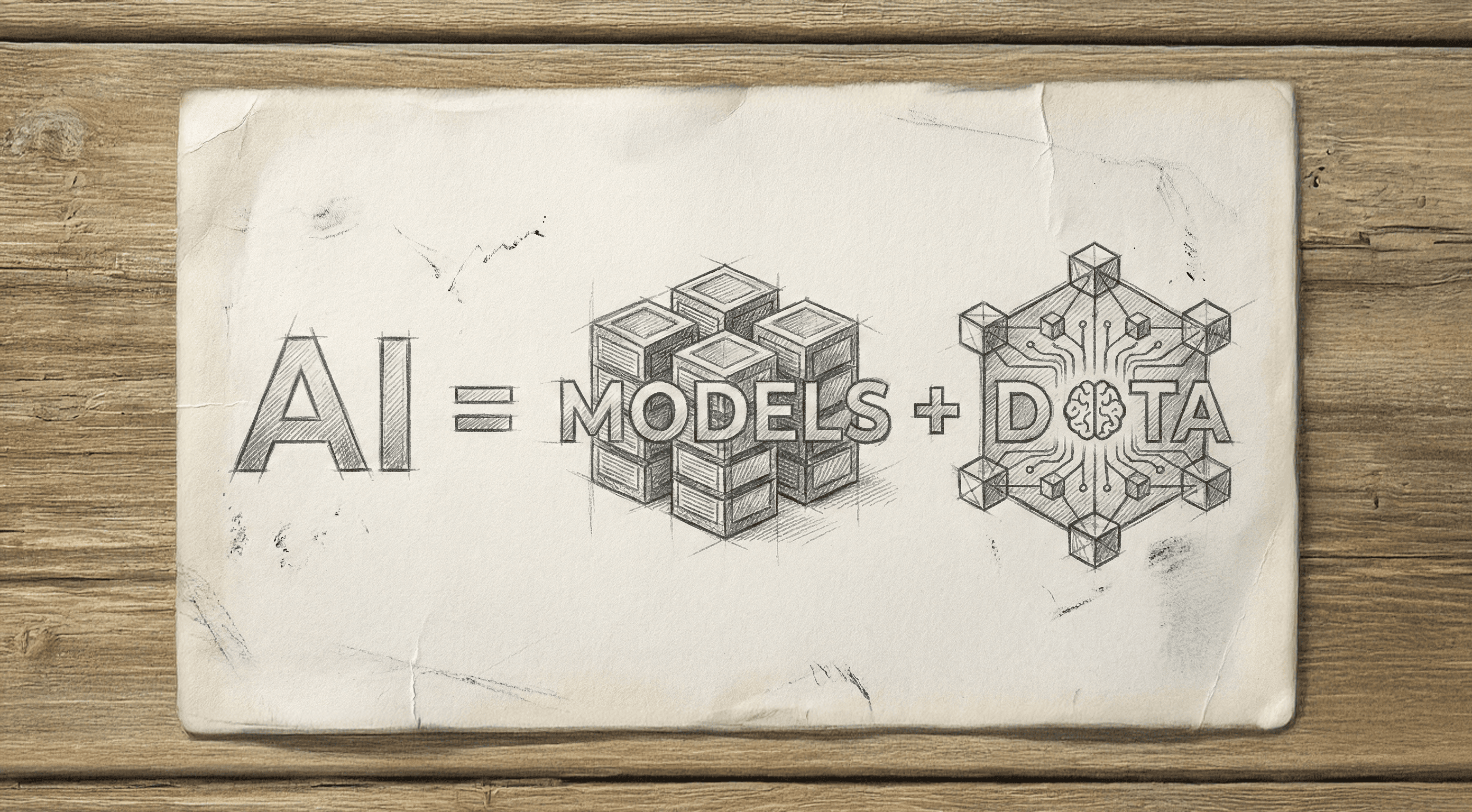
To fix this, we need to strip away the buzzwords and look at what AI actually is. At GraphIQ, we view it through a very simple lens:
AI = Models + Data
It looks obvious, but look at where the venture capital is flowing. It’s almost entirely focused on the Models. Everyone is trying to build a bigger, faster, "wider" LLM.
The result? The model market is becoming a commodity. We are heading toward an open-source arms race where thousands of similar models are fighting for the same territory. They are all "shallow and wide"—they know a little bit about everything, but they struggle with depth and accuracy.
The Pivot to Agents and Graphs
The market is realizing that a chatbot that hallucinates isn't enterprise-ready. The conversation is now shifting toward Agents.
AI Agents are the digital specialists. They are task-oriented and capable of executing complex workflows. But here is the catch that most people miss: An agent is only as smart as the library you give it access to. You can have the most sophisticated agent in the world, but if it’s looking for answers in a chaotic, unstructured swamp of data, it will fail.
This is where the puck is actually heading: Knowledge Graphs.
If you want to stop hallucinations, you have to stop relying on the model's pre-trained memory and start grounding it in your own structured data.
Models provide the reasoning capability.
Knowledge Graphs provide the facts.
Imagine a system where the AI isn't guessing the next word based on the entire internet, but is retrieving specific, curated insights from your organization's own structured data. That is how you move from "fun toy" to "business asset."
The Future is Data, Not Just Models
The "Model" side of the equation is largely solved; they will keep getting incrementally better. The Data side, however, is woefully underdeveloped.
The winners of the next era won't be the companies using the flashiest version of GPT. They will be the companies that have structured their proprietary data in a way that allows AI to actually use it.
At GraphIQ, we aren't chasing the model war. We are focused on the infrastructure that makes those models useful. Because eventually, the hype will die down, and we’ll be left with a simple truth: The real power of AI doesn’t come from asking better questions. It comes from giving it better answers.
Malcolm De Leo
CBO
Share