Blog
Insights
AI = Models + Data: Why the Data Layer Decides Everything
Most B2B founders obsess over which AI model to use. GraphIQ.AI co-founder explains why the data layer - not the model - determines whether AI actually works.

Malcolm De Leo
CBO
AI = Models + Data: Why the Data Layer Decides Everything
When GraphIQ.AI started, we did what founders are supposed to do. We went to test an idea.
The idea was specific: use trucking data to map supply chains. It had real ingredients - logistics data, a structural market problem, a technical angle. We got out of the building. Talked to more than 40 business executives across different industries, different company sizes, different contexts.
We asked what they thought of the idea. And more importantly, what was the hardest part of running their business.
We didn't get a range of answers. We got the same one. Every single time.
That's not validation. That's a signal loud enough that ignoring it would take deliberate effort.
The conclusion was uncomfortable but unavoidable: we were testing the wrong idea. And the actual problem was sitting in what we kept hearing:
"There's no easy way to find companies to do business with. I either call who I know, use Google, or hire a consultant."
Three options. That's the infrastructure underneath one of the most consequential decisions any business makes - finding customers to sell to and suppliers to buy from.
Call who you know. Google it. Hire a human.
That's not a system. That's improvisation dressed up as process. Messy? Yes. Effective? Sometimes. Scalable? Not a chance.
So we pivoted. Once. Clean. Directly based on what the market said. We built GraphIQ.AI to solve the actual problem: a B2B entity graph that makes business relationships structured, machine-readable, and usable at scale. Not a contact list. Not enrichment fields on top of a spreadsheet. A graph - where companies, people, and relationships connect with context and attribution.
Then 2024 arrived and rearranged the conversation.
"I use Google" became "I use ChatGPT." Seemingly overnight, every conversation started from the same place: "Can't I just use ChatGPT for this?"
Fair. It's exactly the right question when something new shows up promising to do everything.
But this is where most founders, operators, and product teams get into trouble. They start confusing fluency with accuracy.
LLMs are extraordinary at producing text that sounds correct. They are meaningfully less reliable at being correct. This is not a model quality problem that the next release will fix - it's structural. Research cited by Atlan (2026) on Suprmind.ai puts it plainly: LLM hallucination rates drop 87% when models operate against well-structured versus unstructured sources. The model does not get smarter. The data layer improves. Better inputs produce better outputs. The model gets credit for something the data layer earned.
Most teams building with AI right now are skipping the data layer entirely, or are running on extremely costly, unstructured web search. The focus is on the model - better, faster, cheaper, more capable. It's an arms race. And I understand the appeal. Models feel like leverage. They're tangible. You can point at benchmarks, show demos, compare outputs.
But if you don't control the data, the model is running on a guess. A well-written, confidently presented guess.
We've seen this pattern before. The founder who calls three customer conversations product-market fit. The sales leader who commits a number with no qualified pipeline behind it. The executive who trusts the dashboard even though it's measuring the wrong things. Confidence without grounding is not insight. It's noise with better formatting.
Now we're in 2026 and the language has shifted again.
"I use ChatGPT" is becoming "I use Claude Code to build my own solution." People are vibe coding. Spinning up MCP servers. Stitching together their own GTM data workflows. Give founders power tools and they build. Don't get me wrong, I'm here for it. Sometimes its something impressive. Often it's something built on the same shaky foundation the problem started with.
The equation hasn't changed:
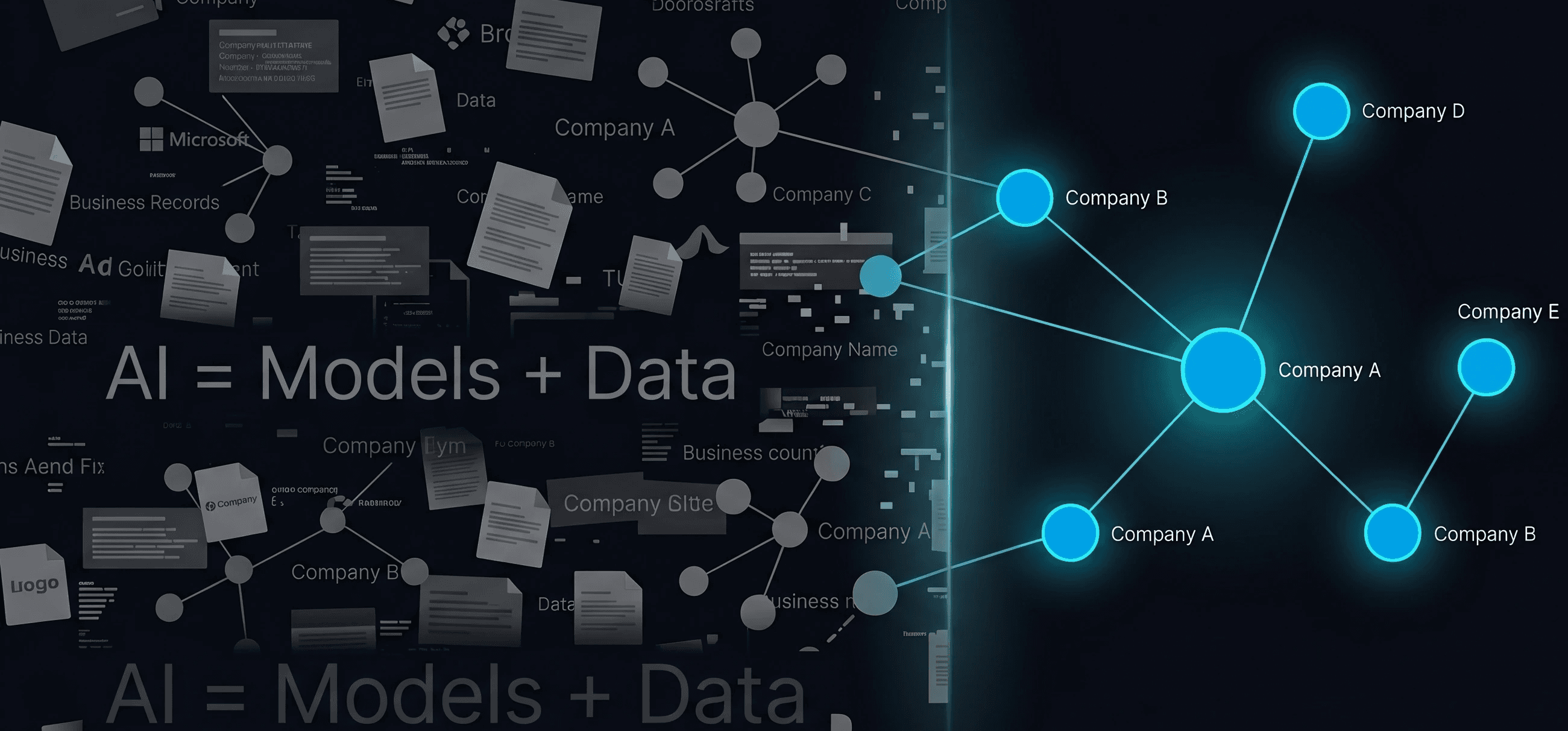
AI = Models + Data.
Almost all the attention is on the left side.
Gartner projects that by 2028, 90% of B2B buying will be AI agent intermediated, representing over $15 trillion in B2B spend flowing through AI agent exchanges. That's the market these workflows are supposed to serve. And in that market, your AI agent is only as reliable as the data it's working from.
Bad foundation. Bad agent. At scale. Without pausing to second-guess itself.
I call this being data blind. In a GTM context, data blind means running AI-powered workflows on unstructured, incomplete, or unverified business data. The outputs look confident - the model presents them that way. But the underlying information can't be trusted, so the decisions built on that information can't be trusted either. You can ship fast. You can report convincingly. Reality shows up eventually.
What a data layer actually does
Most AI implementations today work like a library where every book ever written is dumped into a single pile, and you ask the model to find the answer. Sometimes it works. Sometimes it hallucinates. You often cannot tell which one happened until it matters.
A structured B2B entity graph works differently. You define the relationships. You control the entities. You decide what data the model is working with - and more importantly, what that data means in context. Then you bring the model in. Now it's not inferring company ownership structures or guessing at organizational hierarchies from training data that may be months or years out of date. It's operating against structured, real-time, verifiable information.
That's the difference between a system and an expensive autocomplete.
GraphIQ.AI is the data foundation - global, structured, real-time B2B entity data - built so AI systems have something solid to work from. Not as another model. Not as another tool added to a stack that already has too many layers. As the part most people are skipping.
The question most founders are asking: Which model should I use?
The question that determines whether any of it works: What data am I trusting that model with … and do I actually understand it?
The hard way is almost always the right way. And the right question is almost never the one everyone is asking.
FAQ
What is a B2B entity graph and how does it differ from a contact database?
A B2B entity graph is a structured, interconnected representation of business entities — companies, people, relationships, hierarchies — organized for machine traversal. A contact database is a list with enrichment fields on top. The distinction matters because AI systems need relationships and context to reason accurately, not just records. A list tells you a company exists. A graph tells you who it's connected to, how, and what that means for your use case.
Why do LLMs hallucinate in B2B applications?
They're pattern-matching against training data that may not include your market, your prospects, or current organizational structures. When models are grounded in well-structured sources, hallucination rates drop 87% (Atlan, 2026). The fix is the data layer, not the model version.
What does AI = Models + Data actually mean?
AI accuracy depends on two inputs: the model (the reasoning layer) and the data (the knowledge layer). Most companies over-invest in model selection and under-invest in data structure and quality. The data layer sets the ceiling on what the model can accurately produce. A better model on bad data still produces bad outputs - faster.
What does "data blind" mean in a GTM context?
It describes a GTM team running AI-powered workflows on unstructured, incomplete, or unverified data. The outputs look confident because the model presents them that way. But if the underlying information cannot be trusted, neither can the decisions it's producing.
How does GraphIQ.AI help AI agents produce accurate B2B outputs?
GraphIQ provides a structured B2B entity graph - real-time, global business data organized so AI agents can navigate relationships, verify company data, and operate from grounded context rather than inference. It's the data layer that makes GTM AI reliable rather than just convincing.
What is vibe coding in a GTM context and why is the data foundation still a problem?
Vibe coding - using AI tools like Claude Code to rapidly build custom solutions - has made it possible for non-engineers to spin up GTM workflows, MCP servers, and data integrations quickly. The speed is real. The risk is that the underlying data those workflows depend on is often unstructured or unverified. You can build faster on a bad foundation. The foundation doesn't get better because the tools improved.
Malcolm De Leo
CBO
Share